
The Finney County 72-Hour Release List
No official Finney County rolling 72-hour release feed was found. The sheriff's current roster is refreshed regularly during the day, but it does not retain a public three-day release archive. A person who leaves the roster may have posted bond, finished a county sentence, received a court order, transferred to KDOC, moved to another jail, or entered another authority's custody.
The three-day window is useful as a records-request range. Define it with exact start and end dates and times. “Past three days” can mean three calendar dates or the preceding 72 hours, and those are not always identical.
How to Check Who Was Released in the Last 72 Hours
Sheriff Records is the official local fallback. The office is at 304 North Ninth Street, Garden City, KS 67846, and publishes (620) 272-3756. No fixed fee, response time, or online retention term was verified, so ask what format is held.
- Choose exact start and end times.
- Ask for release or disposition records, not the current roster.
- Include a name and booking number for one person.
- Check the court case for bond or judge-ordered action.
- Verify any transfer with the receiving agency.
Use 24-Hour Releases when the inquiry is limited to one day.
What the 72-Hour Release List Shows
A requested release record may provide the needed facts, but its precise fields depend on what Sheriff Records can release. State the requested elements without claiming the public roster contains them.
| Requested element | Why it matters |
|---|---|
| Name and booking number | Links the response to the correct booking. |
| Release date and time | Places the event inside the range. |
| Disposition type | Separates bond, sentence completion, court action, and transfer. |
| Releasing facility | Identifies which custody ended. |
| Receiving agency | Shows whether custody continued. |
The roster verifies booking fields, not a history of releases. The official screen illustrates those controls:
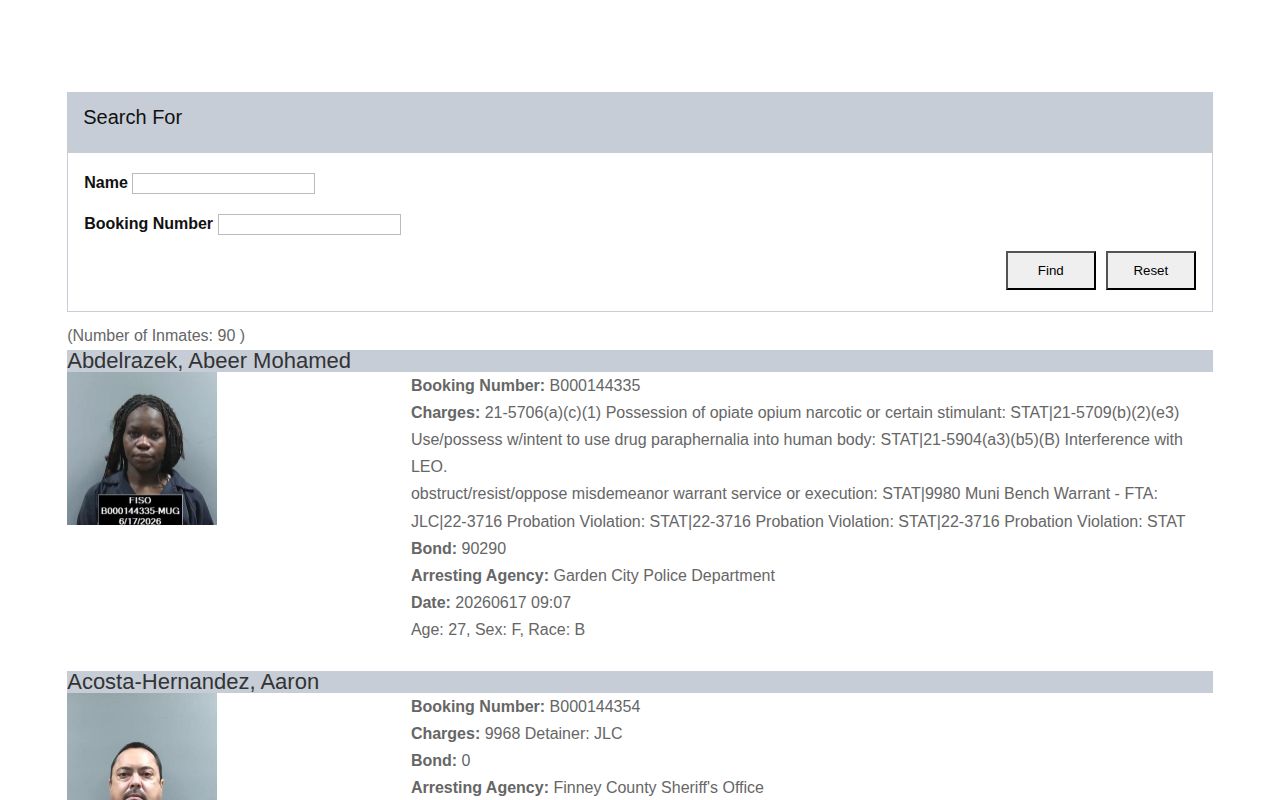
The screenshot is a starting point for identification, not a three-day archive.
Weekend and Holiday Releases
A 72-hour request can cross a weekend, holiday, or office closure. The custody event may occur while the records response comes later. Ask for the actual event time rather than using the time a website changed. The roster's exact update interval is not published.
For one named person, search Finney County released inmates through the full agency path. Sheriff Records answers the local historical event. A court record explains the case action, while a receiving agency confirms continued custody after transfer.
If There Is No 72-Hour Release List Online
Kansas VINE covers county-jail custody and offers custody-change notices. It does not cover KDOC prisons. A notice may describe release, transfer, or escape, so confirm it with Sheriff Records. For a person moved to state corrections, use KASPER and KDOC records.
Federal and immigration systems are separate. The Bureau of Prisons locator serves federal prison records. ICE has its own locator and limits. An immigration detainer can result in transfer rather than community release. Court dockets and warrants add context but do not replace the jail disposition.
Why Finney Records Need Requests
The Finney County Jail Division says a person absent from its regularly updated roster probably is not in its custody, then routes historical information to Records. This local archive gap means current data is rich while release history does not remain in a verified public gallery.
The sheriff source shows that split:
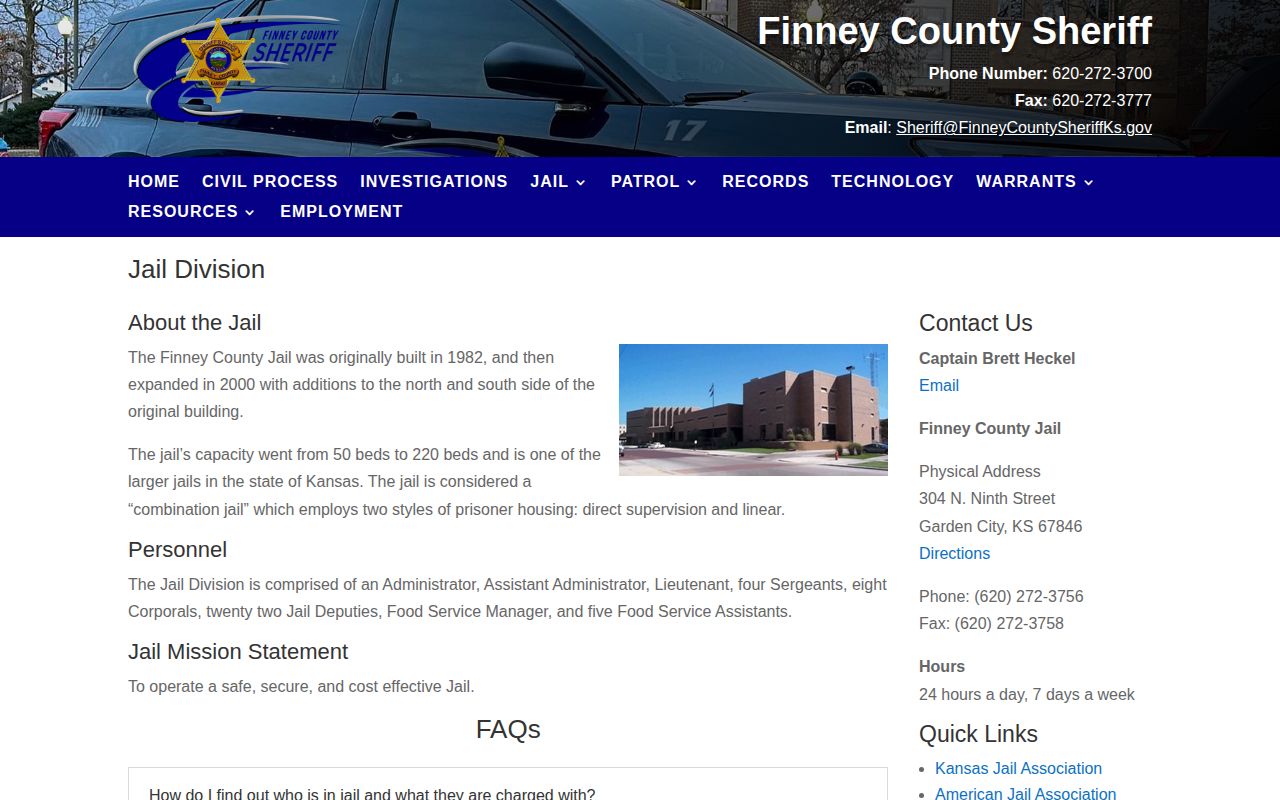
A missing entry is a clue, not a reason code, release time, or destination.
Do Not Manufacture Finney Releases
Saving three days of roster cards and subtracting names produces a change log, not a release list. Disappearances can represent transfer, correction, or another data change. New cards reflect bookings, not the reverse event. The sheriff has not represented those differences as a historical release product.
A records-based list should preserve its range, source, request date, and the office's terms for each event. If a receiving agency is named, verify that leg too. This keeps release to the community distinct from custody elsewhere.
Finney County Three-Day Dispositions
Several outcomes can end a jail roster entry during a three-day span. Bond releases end the jail hold for a case, subject to any other hold, but do not dismiss the charge. Time served means the court credits custody toward the ordered term. A court-ordered release may follow a case action. Sentence completion ends the jail portion, while transfer moves custody to another authority.
Ask Records to preserve the agency's own disposition wording. A release to the community, a transfer to KDOC, and movement under an immigration detainer should not share one generic label. If the record names a receiving agency, check its locator or records office. If it cites a court action, compare the docket and filed order. The jail record remains important because the court action and the physical exit are separate facts.
- Bond release
- Exit after bond conditions are met, subject to other holds.
- Time served
- Custody credited as the ordered term or part of it.
- Transfer
- Custody continues with another authority.
- Discharge
- Completion of a sentence or supervision duty, depending on context.
Match Finney Release Identities
A booking number is more precise than a name. The live Finney roster supports name or booking-number searches, so capture that number when lawfully available for a permitted custody inquiry. Common names, spelling changes, and multiple bookings can otherwise cause the wrong event to be assigned to a person.
For a range request, ask Records to return enough identifying information to distinguish separate bookings without seeking data the office cannot lawfully disclose. A booking date can separate two stays. The arresting agency can route a follow-up. Charges help match the case, but they are allegations at booking and do not state the final outcome. Compare the court case before describing any disposition.
Finney Release Alerts Are Not Lists
No official Finney sheriff recent-release mobile app was verified. VINEMobile provides Kansas VINE custody search and notice tools, but it does not publish a Finney County three-day release gallery. Registering on one person's record supports future notice. It does not produce a complete county date-range response.
Use the right channel for the question. Sheriff Records handles the requested historical range. VINE gives a person-specific custody-change notice. The court explains the case action. KDOC handles state-corrections status. Treating those sources as complementary avoids forcing one system to answer a question it was not built to answer.
Define the Finney Release Range
A clear request can say that it seeks release or disposition records for Finney County Jail from a stated start time through a stated end time. Specify local time and whether the range includes both endpoints. Ask for actual event times, disposition descriptions, booking numbers, and receiving agencies if those fields exist and may be released. This wording avoids asking Records to calculate a vague “last three days” period after the request arrives.
For one person, include the full name, known booking number, and approximate booking date. Do not rely on age or a common name alone. If the office quotes a fee or requests clarification, narrow the range or identifiers without changing the core need for the actual release event. No standard Finney fee or turnaround was verified, so preserve the office's current answer.
Trace Finney County Transfers
The Sheriff's Warrant Division identifies transport of convicted people into KDOC, extradition, retrieval, and local movement as sheriff functions. That local fact explains why a person can leave the county roster and still be incarcerated. A transfer disposition should name or help identify the next authority. Use KASPER for KDOC, the other county's jail source for a jail transfer, and the appropriate federal or immigration locator for those systems.
Transfer time is not a state-prison release date. KASPER may update on its own cadence, and the receiving record should be matched by identifier rather than name alone. If no destination appears in the public view, ask the sheriff or receiving office. This follow-through is what separates a reliable 72-hour disposition list from a list of names that merely vanished online.
Review Finney Three-Day Results
Before treating the response as complete, check that every listed event falls within the requested hours and that each disposition has a source. Separate community releases from transfers. Flag any unclear code for follow-up with Records, and do not fill a missing field by inference. If the office supplies only part of the range, preserve that limitation with the result.
A well-defined three-day record can support personal knowledge, reconnection, custody verification, and legal or court process. Its value comes from the actual event record, not the appearance or disappearance of a public roster card.