
Finney Projected Versus Actual Release
A projection is a calculation made within one sentence and custody system. It is not the completed exit event. The date may refer to the prison portion of a sentence, eligibility for parole review, the end of postrelease supervision, sentence discharge, or the actual jail release. These labels are not interchangeable.
A person held before trial at the Finney County Jail often has no scheduled release date. Bond may be posted, the court may change the order, a case may end, or another agency may place a hold. Even a completed local sentence can lead to transfer rather than a return to the community. Sheriff Records can confirm the recorded release or transfer disposition after the event.
Find Finney Projected Release Dates
Start with the current Finney jail roster for local custody. It shows current booking information, not a reliable future exit date. For a county sentence, ask the jail and sentencing court about the term, credit, order, and any hold. After release, the Records Division supplies the historical disposition route.
For a Kansas prison sentence, use the KASPER offender search. The research did not verify a static detail page with a universal field called “projected release date.” Do not invent that label. Open the live offender detail, identify the exact date and status label shown, note the timestamp and custody scope, and confirm with KDOC.
- Identify the Finney booking number, court case number, or KDOC number.
- Determine whether the person is in county jail, state prison, or community supervision.
- Open the responsible official system and match multiple identifiers.
- Copy the exact label beside the date, such as parole eligibility or postrelease end.
- Check the sentence order for consecutive terms, jail credit, and later changes.
- Confirm the completed event with Sheriff Records, KDOC, the court, or the receiving agency.
The KASPER screenshot shows the official Kansas search controls and record route.
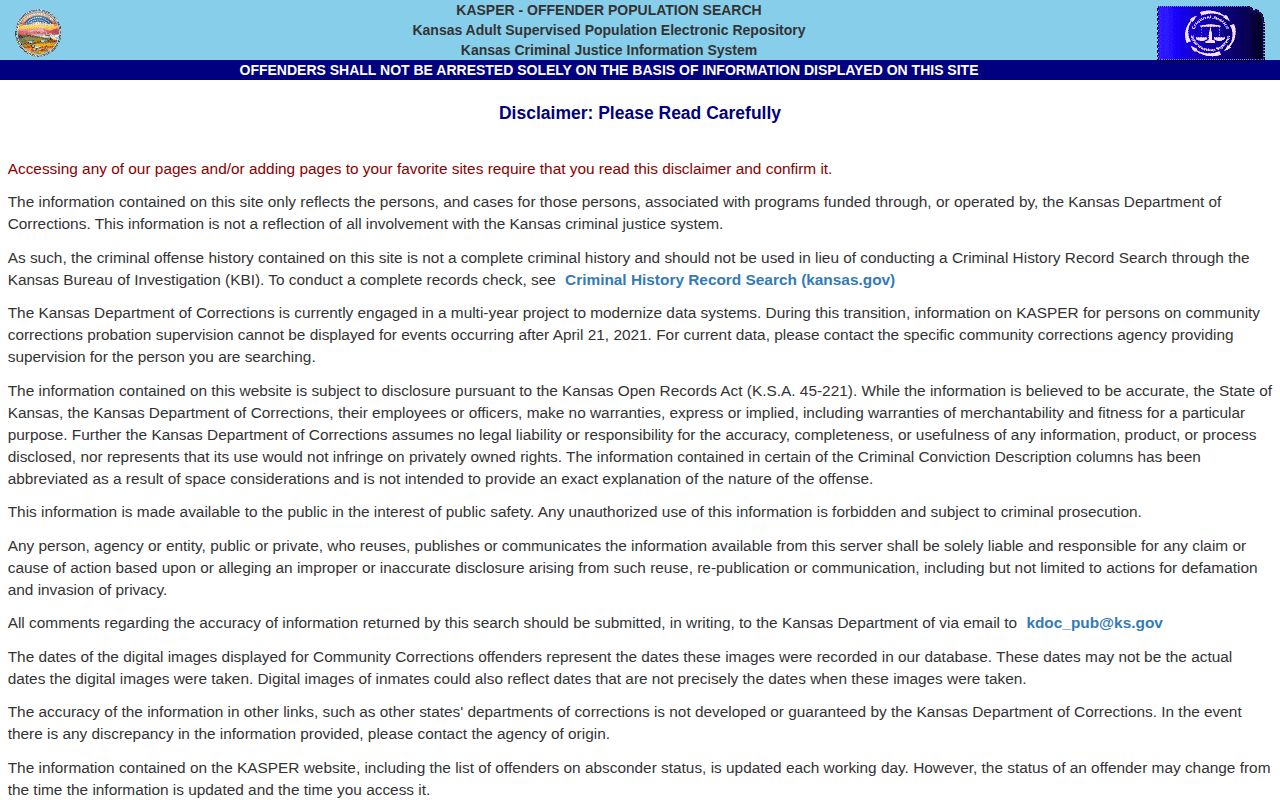
Use the live result's own labels. A search result should never be restated as a firm community release without checking the actual event.
Finney Release Date Sentence Labels
Kansas sentence structure determines what can be calculated. K.S.A. 22-3717 separates older indeterminate and parole-eligible terms from many sentencing-guidelines determinate terms. For eligible indeterminate sentences, good time may affect when parole eligibility arrives, but eligibility only opens review. It is not a release grant.
Many non-off-grid offenses committed under the guidelines use a set prison portion followed by mandatory postrelease supervision. The controlling offense date, severity, and statutory exceptions matter. Certain life, off-grid, class A, and other specified sentences follow special or mandatory rules. A person can leave prison and still owe a postrelease term.
Older indeterminate calculations differ again. KDOC explains that a qualifying sentence with a two-year minimum can earn one day per day toward parole eligibility, while a one-year minimum can reach eligibility after nine months. Conditional release is ordinarily tied to half the maximum when applicable good time is retained. These are agency explanations of particular structures, not shortcuts for every case. The judgment, offense date, exclusions, and KDOC computation must agree.
- Projected prison release
- An estimated exit from the prison portion, subject to recalculation and holds.
- Parole eligibility
- The point when an eligible sentence may receive release review, not a promise of release.
- Postrelease end
- The calculated end of community supervision after a determinate prison term.
- Sentence discharge
- The formal end of the sentence obligation.
- Actual jail release
- The completed local custody exit or transfer recorded by the sheriff.
Finney Release Dates and 85%
Kansas's familiar “85%” phrase is not a universal release formula. The Prisoner Review Board process explains that sentencing-guidelines prisoners may earn no more than 15 to 20 percent good time, depending on the offense date. Serving 85 percent is shorthand only where a 15 percent maximum applies. Other guideline cases can have a different cap. Older indeterminate, off-grid, life, mandatory, and parole-eligible sentences do not fit that simple arithmetic.
Good time is earned credit recognized under the applicable rules. It may be limited, withheld, or lost. Retained credit can reduce the prison portion while being added to postrelease supervision, so it may not shorten the full sentence obligation. That is why multiplying the pronounced term by 0.85 can produce a false date.
The offense date is essential because Kansas sentencing rules have changed over time. Severity level also matters, as do mandatory minimums and the distinction between on-grid and off-grid offenses. “On-grid” means the sentencing-guidelines grid governs the term. “Off-grid” identifies an offense handled outside the ordinary grid framework. Neither term alone supplies a date. The full sentence record must show the controlling count and structure.
The KDOC process source displays its good-time explanation and parole decision terms.

The source reinforces the need to name the sentence scheme and offense date before estimating a Finney County release.
Parole-eligible cases add a decision step. The Prisoner Review Board may use the terms Parole, Continue, or Pass. Parole means the board found the person suitable for release, subject to remaining requirements. Continue means more review, information, votes, or evaluation are needed. Pass denies parole for a stated period. A hearing date, a continue, or even an eligibility date is not the actual exit from prison.
Why Finney Release Dates Change
A computed date can move, or two accurate dates can describe different events. Court and agency records should be read as a timeline. Consecutive sentences run one after another, while concurrent sentences run at the same time. A detainer is another authority's hold or transfer request. Neither detail can be resolved from a single date displayed without context.
| Factor | Effect on the date | Record to check |
|---|---|---|
| Jail credit or court correction | Changes credited time or sentence calculation | Filed order and agency computation |
| Earned credit | May reduce the prison portion within governing limits | KDOC computation and policy |
| Disciplinary loss | May reduce available credit | KDOC disciplinary and calculation record |
| Consecutive counts | Creates an aggregate term unlike one count alone | Judgment and sentence computation |
| Parole decision | Eligibility may lead to parole, continue, or pass | PRB and later KASPER status |
| Detainer or hold | Can turn release into transfer | Holding and receiving agencies |
| Court modification | May recalculate the controlling sentence | New filed order and agency update |
Note: A court release order and physical exit are related facts, but another valid hold can keep the person in custody.
Confirm Finney Actual Release Dates
For a county-jail event, Kansas VINE can provide custody-change notification, but an alert may describe release, transfer, or escape. Those events differ. Kansas VINE covers county jails and excludes KDOC prisons. Use the VINE Inmate Check for notification, then request the recorded disposition from Finney Sheriff Records.
For a state prisoner, later KASPER status, KDOC Community and Field Services, and a focused state records request are the proper channels. KDOC's GovQA portal supports submission and tracking. Ask for the sentence computation, actual release event, postrelease placement, or discharge record needed. For a Finney court sentence, obtain the filed order from the court and compare it with the jail exit.
A useful chronology reads: Finney booking, sentencing order, sheriff transfer if any, KDOC admission, date projection with its label, actual release or transfer, supervision placement, and discharge. Each entry needs a source and date. That approach avoids collapsing a long custody history into one ambiguous “release date.”
Federal and immigration custody require different checks. The Bureau of Prisons locator can show a federal release date for post-1982 records, while an ICE locator may include some releases within its limited recent window. Neither system computes a Finney County jail date. If the sheriff records a transfer to another authority, use that destination's record to learn whether custody continued.
Weekend or holiday timing should not be guessed. No routine Finney release hour, exit door, or weekend processing policy was verified. A projected date falling on a closed Records day may still require later confirmation. Preserve the date and time of any live roster or VINE check, then contact Records when its office reopens.
Keep a source note beside every date. Record the agency, exact field label, time viewed, identifying number, and whether the value was projected or completed. If a later record changes the date, retain both entries and the reason when stated. This matters when jail credit, a corrected order, or disciplinary action triggers recalculation. It also prevents a postrelease end date from being mistaken for a prison exit.
When records conflict, contact the agency responsible for the calculation. The sheriff can confirm its local exit, but it cannot certify a KDOC computation. The court supplies its order, while KDOC applies that order within the state sentence record. A receiving agency confirms a transfer. Resolving the timeline may therefore require more than one official answer.
Finney Release Date Records
Finney Sheriff Records is at 304 N. Ninth Street, Garden City, KS 67846. The office can be reached at (620) 272-3700, with fax at (620) 272-3777, during published weekday hours from 7 a.m. to 5 p.m. Ask for the booking and release or transfer disposition tied to a booking number or narrow date range. The sheriff has not published a fixed fee, turnaround, or retention period for this record.
Kansas open-records law requires a response as soon as possible and by the end of the third business day, but that is not a promise of full production by then. Reasonable actual production costs may apply. If the requested record cannot be supplied at once, the custodian can explain the delay and state when and where it should be available.
A completed release record can then be compared with the broader Finney County released inmate search. Keep the actual exit time separate from any earlier projection.
No verified Finney source publishes a routine release hour or promises that a stated date will remain unchanged. Ask for the completed event after the date passes. If the answer is transfer, record the receiving authority and continue the check there. A county release timestamp confirms only the end of that county hold.
Use the latest official record available. Older screenshots can explain what was once displayed, but they cannot replace a later correction, court order, or completed release entry.