
Where Finney County Jail Releases Go
A release from Finney County Jail is an end to this jail's custody, not always a return to the community. A person may leave after bond, a court order, completion of a local sentence, or another lawful disposition. The Sheriff's Office may instead transfer a convicted person to the Kansas Department of Corrections, return someone to another jurisdiction, complete an extradition, or turn the person over under another agency's hold.
The sending record and receiving record should form one timeline. Sheriff Records can identify the recorded jail exit and disposition. A court docket can explain the order or bond event. KASPER can confirm entry into KDOC, while the receiving county or federal agency must confirm its own custody. A missing roster card alone cannot choose among those outcomes.
| Recorded path | Best next check |
|---|---|
| Bond or court release | Sheriff release history and the filed court event |
| Sentence completed | Jail disposition and sentencing case |
| KDOC transfer | KASPER and KDOC admission record |
| Extradition or other hold | Sending record plus the receiving authority |
| Immigration transfer | ICE locator or detention contact, subject to its limits |
Confirm a Finney County Jail Release
The official Finney County jail roster is the first check for present local custody. It accepts a name or booking number and can display booking details. The sheriff says it updates regularly during the day, but it is not a release archive.
- Search the roster and record the check time and booking number.
- If the card is absent, treat that only as a clue that Finney custody may have ended.
- Ask Sheriff Records for the booking release date and time, disposition, authority, and receiving agency when releasable.
- Compare the court case if bond, dismissal, sentence completion, or another order explains the exit.
- Check KASPER, VINE, ICE, or another receiving agency only when that custody path fits the record.
The full named-person workflow and release-record field list are on the Finney County released-inmates search guide. It distinguishes county, state, federal, and immigration systems so that a result from one is not mistaken for release from all custody.
Roster absence does not identify release time, reason, destination, or whether another authority took custody.
Finney County Jail Records Contact
Operational questions and historical records go to different points within the Sheriff's Office. The jail can address immediate custody operations. Once a person has been released, the sheriff directs past-incarceration questions to the Records Division.
Jail and Records
Finney County Jail
304 N. Ninth Street
Garden City, KS 67846
Jail: (620) 272-3756
Fax: (620) 272-3758
Sheriff Records Division
304 N. Ninth Street
Garden City, KS 67846
Phone: (620) 272-3700
Fax: (620) 272-3777
Monday through Friday, 7 a.m. to 5 p.m.
A focused request should identify the person and booking number or approximate date range. Ask for admission and release date and time, release or transfer disposition, releasing authority, receiving agency or destination if releasable, and the booking photograph. The public Records page does not publish a fixed fee, production time, or retention period for these items. Ask for a cost estimate and the legal basis for any withheld portion.
About the Finney County Jail
Finney County Jail is the adult local detention facility operated by the Finney County Sheriff's Office. It holds local pretrial and short-term detainees as well as people awaiting court action, transfer, or sentence processing. It is not a state prison, so KASPER is not the routine source for every jail booking.
The sheriff describes a design combining direct-supervision and linear cell layouts. Capacity grew from fifty beds to the present published figure through the expansion. These facts describe the building, not annual release volume. No verified annual release count, average stay, or turnover figure was found.
Finney County Jail Booking Records
A current roster card can include name, booking number, charges, bond, arresting agency, booking date and time, age, sex, race, and a photo when available. Those fields describe booking and current custody. They do not supply a confirmed exit time or destination.
The booking number is especially useful because the public card may disappear after release. Saving that identifier while the record is current lets Records locate a past booking without relying on name alone. The sheriff's booking-process page explains that staff capture a mugshot and produce an identification card bearing the person's name and booking number.
The official booking-process page shows the local intake and photo workflow.
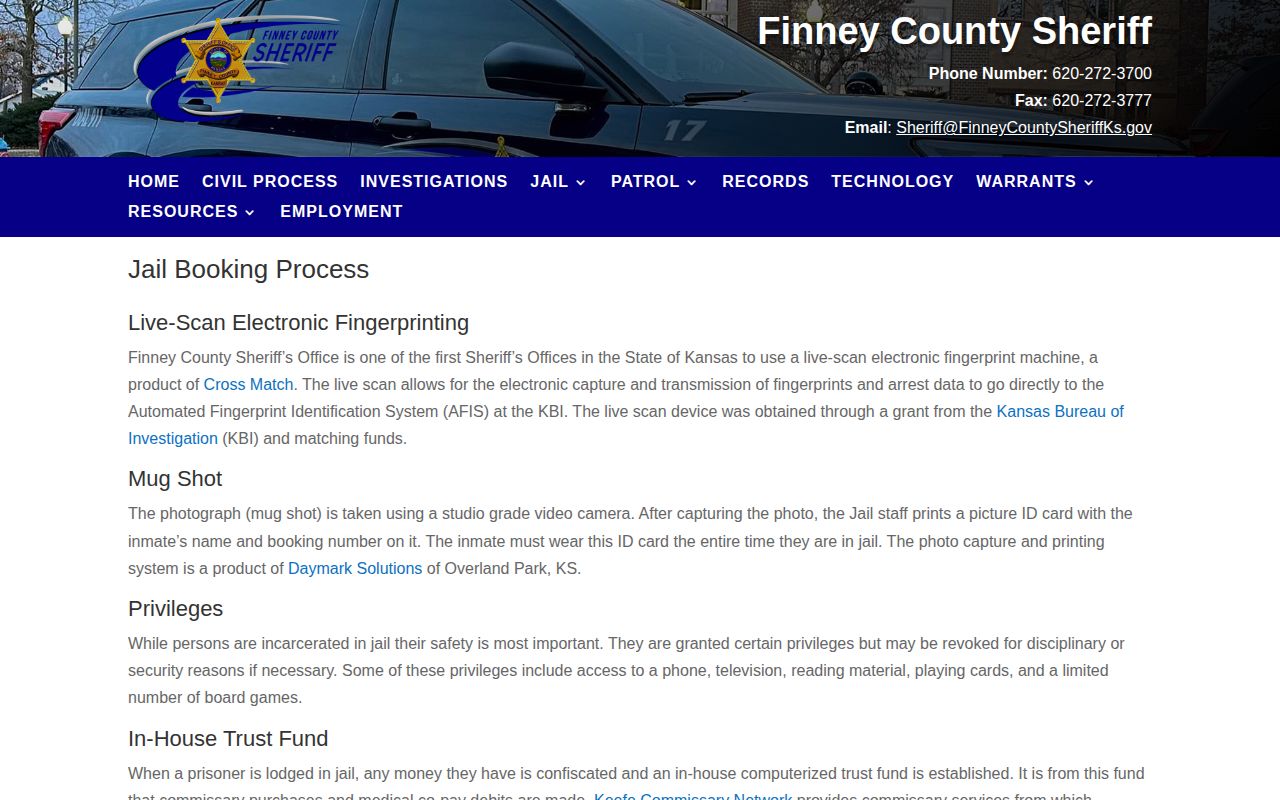
That image documents a booking link, not guilt, conviction, release, or current custody.
Bond Release at Finney County Jail
The Sheriff's Office publishes specific bond-taking rules. Jail staff cannot recommend a bondsman. A full cash bond may be paid by certified cashier's check, money order, or exact cash payable to the Finney County Sheriff's Office. The court may apply posted cash to costs or fines.
Posting an accepted bond can end the jail hold for the covered case, subject to processing and any other holds. It does not dismiss the charge, complete the court case, or prove sentence discharge. For exact timing, pair the bond or court record with the sheriff's physical release entry.
Do not assume a payment receipt is the final jail-exit record when processing or another hold may remain.
Property and Money After Finney Release
The jail permits one release of inmate property while the person is confined. The inmate chooses the recipient, and the person collecting it must show photo identification. Property belonging to someone sentenced to prison, or other property left behind, is destroyed after thirty days under the published jail rule.
Money taken into the trust account is returned on release by debit card or check. Property pickup and trust-fund completion can help a family resolve logistics, but neither is a release-status record. Use Sheriff Records for the actual disposition.
Transfers from Finney County Jail
The Sheriff's Warrant Division handles local medical movement, extradition, retrieval of people arrested elsewhere on Finney charges, and transfer of convicted felons sentenced to KDOC. That operational role explains why someone can leave the county roster and remain incarcerated.
For a KDOC path, compare the sheriff transfer record, sentencing order, and KASPER admission. For another county or state, contact the receiving authority. A federal pretrial matter may require the federal docket and a focused USMS record request. If an ICE detainer led to transfer, the ICE locator can cover current detention and some recent releases, but an absent result does not prove community release.
Finney Release Records Under KORA
Kansas Open Records Act access depends on the record and any applicable exemption. K.S.A. 45-218 requires a response as soon as possible and no later than the end of the third business day, but that is not always the production date. K.S.A. 45-219 permits reasonable actual production costs and advance payment. K.S.A. 45-221 contains exemptions.
Ask for segregable public portions if protected identifiers, medical facts, security information, an active investigation, or another restriction affects the file. Finney County did not publish a fixed release-record fee or retention term in the reviewed material, so confirm both with the custodian.
Reading Finney County Jail Events
Several records may describe the same case at different stages. A booking card establishes the local intake link. A court entry may authorize bond, dismissal, time served, probation, or another result. The sheriff's release history records when jail custody actually ended and how the office classified that exit. None should be silently substituted for another.
Chronology matters when sources appear to conflict. A judge can sign an order before the jail finishes processing it. VINE may report a custody change after the event. A roster page may remain visible briefly or disappear because of a data correction. Record each source's time, wording, and agency scope before reaching a conclusion.
Useful distinctions
Authorized release is the legal basis for an exit. Actual release is the completed jail event. Transfer ends Finney custody while another authority takes control. Discharge may refer to completion of a broader sentence or supervision relationship, not merely leaving this building.
A court order in one case also may not clear a warrant or hold in another. Ask Records for the disposition tied to the booking number, then check another agency only when the recorded facts support that route.
Current Custody Versus Past Release
The sheriff's roster is strongest when it affirmatively displays a current card. Its fields help match the right booking and avoid name collisions. Once the card is gone, the portal supplies no verified rolling archive and no public post-release retention window.
For a past event, provide Records with a narrow date range and enough identifiers to find the booking. Ask whether the response records community release, KDOC transfer, extradition, or another disposition. When arrival at a receiving agency matters, obtain that agency's record too. A sending record proves Finney's exit, while a receiving record addresses what happened next.