
What VINELink Covers in Finney County
VINE is a custody-information and notification service. Finney County links directly to the Kansas service for county-jail searches and alerts. The Kansas Attorney General's VINE page gives the crucial scope rule: Kansas VINE covers county jails and does not cover KDOC prisons. That means a Finney County Jail record belongs here, while a person sent to state prison should be checked through KDOC KASPER.
VINELink is the web interface, and VINEMobile is the app route. Finney County describes telephone, email, text, and in-app notifications. Availability can depend on the live record and interface. VINE is not a Finney County release gallery and does not replace a release or disposition record from the sheriff.
How to Check a Specific Inmate on VINELink
Begin at the official Kansas VINELink interface. Search only with enough detail to distinguish the correct person and select the Finney County agency record. The live controls should govern which identifiers are accepted.
- Open Kansas in VINELink or VINEMobile.
- Enter the available name or identifier.
- Compare identifiers and the reporting agency.
- Open the matching county-jail custody record.
- Read the live status and event label exactly as displayed.
If several people have similar names, do not choose by name alone. Compare any agency, identifier, age, or other displayed detail. For a broader named-person path, use the Finney County release search.
The manifest capture shows the official Kansas search screen:
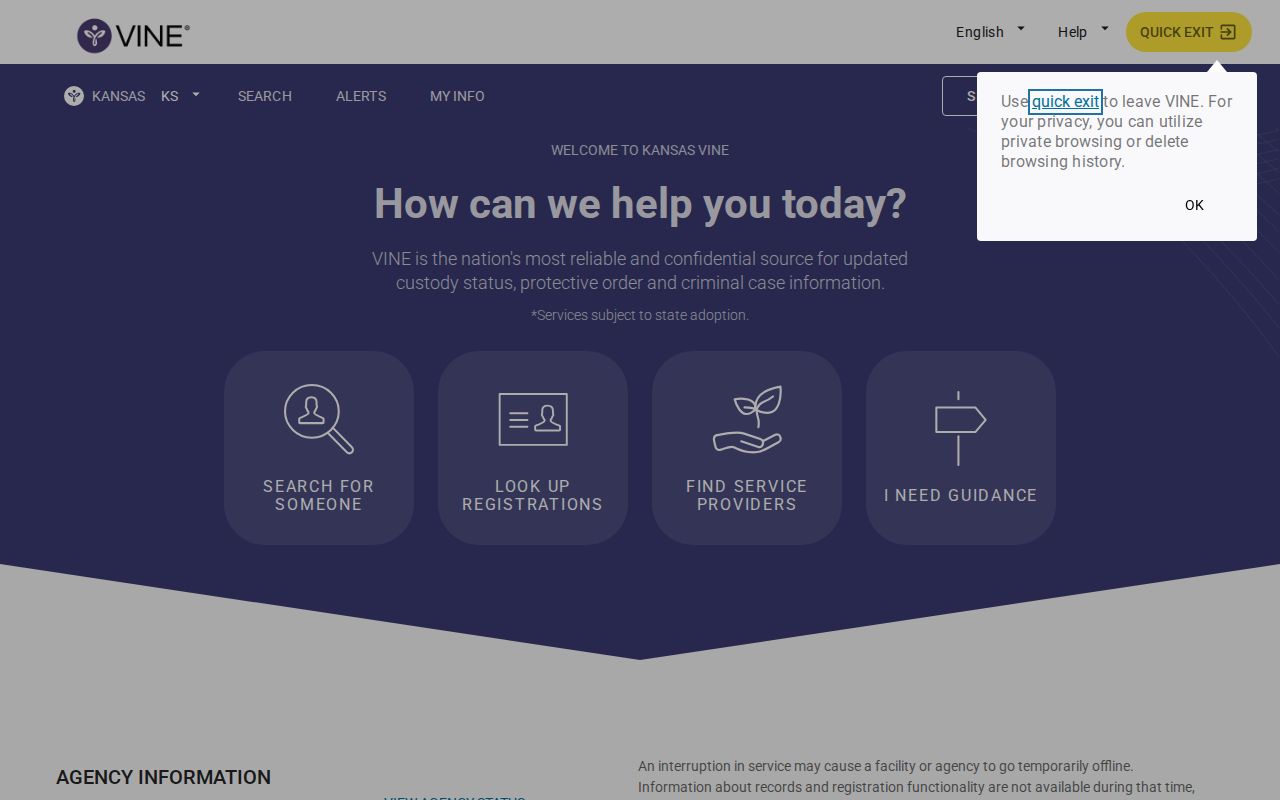
The image confirms the proper statewide starting point without presenting a person's private search result.
What VINELink Shows About a Release
The JavaScript interface did not yield a stable static released-result label or exact date-field inventory during research. Read the live record and do not promise that every result will use the word “Released.” The safe field approach is to note what appears, preserve the event label, and confirm it with the source agency.
| Live item | How to use it |
|---|---|
| Name or identifier | Match the intended county-jail record. |
| Reporting agency | Confirm the record belongs to Finney County custody. |
| Custody status | Read the exact current wording without translating it. |
| Event or location | Distinguish release from transfer or another change. |
| Date or timestamp | Record its label and confirm the event with the sheriff. |
A scheduled date is not an actual release. Likewise, a custody-change notice does not by itself state that the person returned to the community.
How to Register for a Finney County Release Notification
Registration starts from the matching county-jail record. Select a notice route offered by the live service. Official material supports phone and email, while current county and state descriptions also mention text and in-app modes. Follow the interface rather than assuming every mode appears for every record.
- Locate the Finney County custody record.
- Choose registration and an available phone, email, text, or app route.
- For phone registration, create a four-digit PIN. Email registration does not require that PIN under the official guide.
- When an automated call arrives, listen and enter the PIN followed by the pound sign.
- Use the notice to contact the sheriff or receiving agency for confirmation.
Entering the phone PIN confirms receipt and stops repeat calls for that event. Kansas describes live operator and language access, but an automated system should not be the sole plan for an urgent safety concern.
VINELink Limits and How to Confirm a Release
VINE's scope ends at the county-jail boundary in Kansas. Use KASPER for KDOC custody and state supervision. Use the Bureau of Prisons locator for federal prison records. ICE has its own detainee locator and VINE-related routes where applicable. A federal, state, or immigration transfer should not be presented as a Finney County community release.
Data can lag, and an alert is not the formal release record. Contact Sheriff Records at 304 North Ninth Street, Garden City, KS 67846, or (620) 272-3756 for a local disposition. If another agency received custody, confirm with that agency too.
Finney County Hosts VINE Access
Finney County's own Kansas VINE page links the statewide interface and describes phone, email, text, and in-app notices. That local endorsement makes the county page a sound route into a Finney County Jail search. The Attorney General supplies the needed boundary by excluding KDOC prisons from Kansas VINE.
Several official sources publish (866) 574-8463 and TTY (866) 847-1298, while the Attorney General landing page was observed with a conflicting number. Because of that discrepancy, prefer the direct official web or app interface, or verify the number with Kansas AG Victim Services before calling. The office number published for Victim Services is (785) 291-3950.
Read Finney VINE Events Carefully
A release notice means the county-jail custody record changed as reported to VINE. A transfer means another authority may now hold the person. Escape is an unplanned custody event. None should be silently rewritten as another. If the record vanishes from the sheriff roster at the same time, that still does not identify the destination.
- Release
- End of the reported jail custody event, subject to confirmation and other holds.
- Transfer
- Movement from one agency or facility to another.
- Discharge
- Completion of a sentence or supervision duty, which is not always the same as jail exit.
- Current custody
- The agency presently reports that it holds the person.
Match the VINE event to Sheriff Records, a court order, KASPER, or the receiving agency. That final check turns an automated notice into a reliable custody conclusion.
When Finney VINE Has No Match
A failed name search does not establish release. First, check spelling and any identifier available through the live interface. Confirm that Kansas and the correct county-jail agency are selected. The person may be booked under a different form of the name, may not yet be present in the feed, or may have moved outside county-jail coverage.
Next, check the Finney County current roster and contact Sheriff Records. If the person entered KDOC, move to KASPER because Kansas VINE excludes state prisons. A federal defendant may fall under a federal custody route, and an immigration transfer belongs to ICE systems. Each boundary is a routing clue, not proof that custody ended.
Preserve Finney VINE Notice Details
When a notice arrives, write down the exact event phrase, reported date or time, agency, and any identifier. Avoid paraphrasing “transfer” as “release.” If a phone call repeats, entering the registered PIN and pound sign confirms receipt under the official guide. Email, text, and app notices should likewise be read in full.
Then contact the source agency with the same identifier. Ask whether the event was release to the community, transfer, escape, or another change and request the formal disposition when needed. If personal safety is at issue, do not rely only on an automated notice. Use the live operator or appropriate public-safety channel as the circumstances require.
Finney VINE Versus KDOC
A person sentenced from a Finney County case may move from the county jail to KDOC. That transfer crosses the Kansas VINE coverage line. Search KASPER for adult state-corrections status and use KDOC records when a public result does not answer the question. KASPER is updated on its own schedule and should be read with its displayed status and date labels.
Do not register on a county-jail VINE record and assume notices will continue through the entire state-prison term. The county custody event can close at transfer. State postrelease supervision also belongs to KDOC systems, not the county VINE record. Match the KDOC number where available, since names alone can produce the wrong record.
Verify Kansas VINE Phone Access
Finney County's VINE page, the official user guide, and a February 2026 Attorney General news release publish (866) 574-8463. The guide also publishes TTY (866) 847-1298. Research observed a different number on the Attorney General landing page. That unresolved conflict should remain visible rather than being silently corrected.
The safest route is the direct Kansas web or mobile interface. Anyone who needs telephone access can first confirm the number through Kansas AG Victim Services at (785) 291-3950. Once connected, follow the live prompts and record the service information supplied at registration. A verified contact route is particularly important because the four-digit PIN controls acknowledgment of automated calls.
Confirm Finney VINE Release Alerts
Start with the notice, then check the Finney County roster. If the person remains listed, contact the jail about the mismatch. If the person is absent, ask Sheriff Records for the actual disposition. A bond or court order can be compared with the court case, while a transfer should be checked through the receiving agency. This order preserves both speed and accuracy.
The roster itself contains current booking data such as name, booking number, charges, bond, arresting agency, and booking date and time. It has no verified public post-release retention period. VINE adds person-specific notification, but neither source alone becomes the formal historical record. Sheriff Records closes that gap for the county custody event.
Review Finney VINE Registration
After registering, confirm that the selected person, agency, and notice route are correct. Store the phone PIN where it can be retrieved when an automated call arrives, but do not share it with someone who should not acknowledge the notice. For email or text, check that messages are not blocked and keep the official sender details supplied by the service.
A registration can become stale if contact details change. Return to the live service to update or recreate the notice route as allowed. If the record moves beyond county-jail coverage, use the new custody system. VINE registration supports timely awareness, while the sheriff or receiving agency remains responsible for the underlying custody fact.
VINE Notice Versus Release Record
A VINE alert is designed to tell a registrant that a custody event occurred. A sheriff release record documents the agency's actual disposition. The two sources serve different roles. Keep the alert time separate from the release time, since message delivery and source updates may not be simultaneous.
When requesting confirmation, provide the booking number or VINE identifier, exact event wording, and reported date. Ask Sheriff Records whether the event ended local custody and whether another authority took custody. This focused comparison resolves most uncertainty without overstating what the automated interface displayed.